
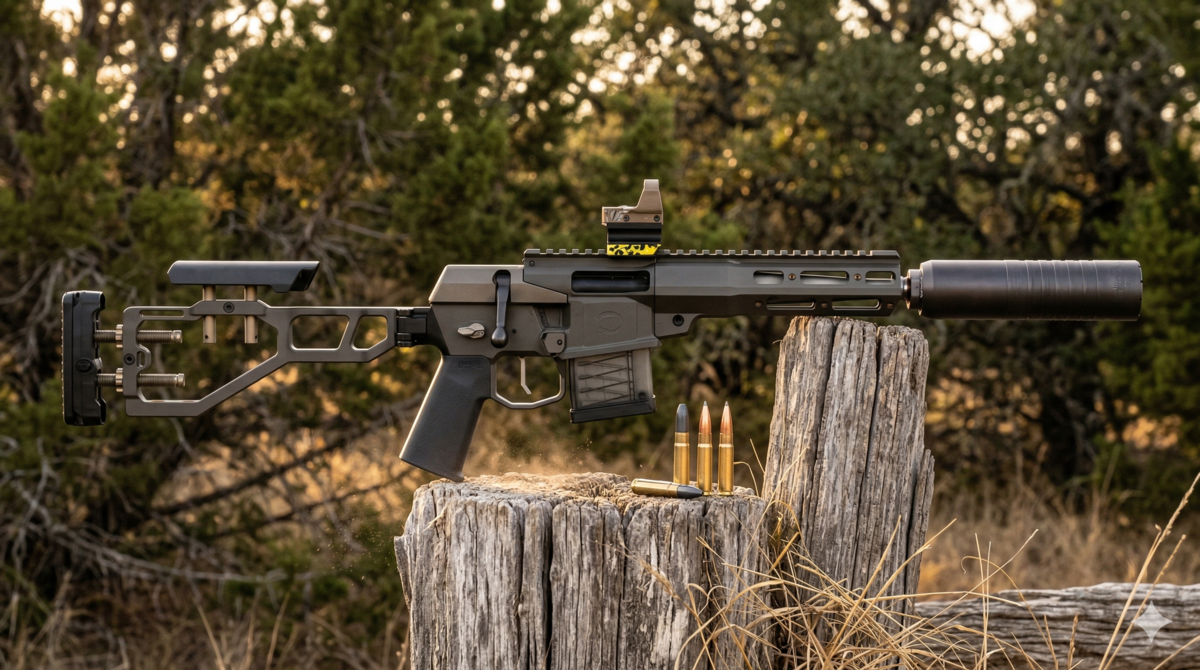
If you're like most hunters with an AR platform, you probably built it around 5.56 NATO and called it good. Nothing wrong with that approach, but you might be overlooking one of the most versatile hunting rounds available today. The .300 Blackout has quietly become one of the most effective medium-game cartridges for hunters who understand its strengths.
What Makes .300 Blackout Different
The .300 Blackout wasn't born in a hunting camp. It was designed for military and law enforcement applications where suppressed fire from short-barrel rifles mattered more than long-range precision. But those same design priorities that made it effective for special operations translate surprisingly well to hunting situations.
Unlike most cartridges that excel in either supersonic or subsonic applications, the .300 BLK offers genuine dual-personality performance. Load it with 110-grain supersonic projectiles and you have a legitimate medium-game round capable of ethical kills out to 200 yards. Switch to 220-grain subsonic loads and you have one of the quietest, most effective suppressed hunting combinations available.
This versatility in a single platform is almost unprecedented. Most hunters need multiple rifles or at least multiple uppers to achieve what .300 Blackout delivers in one package. That's not marketing speak—it's genuine utility that matters in the field.
Terminal Performance on Medium Game
Let's address the elephant in the room: can .300 Blackout ethically harvest deer-sized game? The answer is absolutely yes, with proper bullet selection and realistic expectations about range.
Supersonic .300 BLK loads in the 110-150 grain range deliver excellent terminal performance on whitetail, hogs, and predators inside 200 yards. A 125-grain expanding bullet at 2,200 feet per second carries more than enough energy for clean kills at typical hunting distances. The key is understanding that this isn't a 400-yard cartridge, and hunters who accept that limitation use it very effectively.
We've seen consistent expansion and penetration from quality hunting bullets in this weight range. The .30-caliber diameter gives you excellent bullet selection compared to smaller cartridges, with proven hunting projectiles from every major manufacturer. For hogs especially, the heavier bullets handle bone and tough hide better than lighter, faster alternatives.
The honest assessment is that .300 Blackout sits in the sweet spot for hunters who engage targets inside 200 yards. If you need longer range capability, look elsewhere. But for thick woods, feeders, blinds, and close-range encounters, it's genuinely effective.
The Platform Advantage
Here's where .300 Blackout really shines for AR owners: it runs in your existing lower receiver with only a barrel change. Same bolt, same magazine, same familiar manual of arms you already know. This isn't theoretical—it's practical compatibility that saves money and training time.
For hunters who've invested in an AR platform, this compatibility represents enormous value. You don't need a new rifle, new magazines, or new muscle memory. Swap the barrel, zero the optic, and you're hunting with a purpose-built medium-game cartridge in a platform you already understand.
The short, maneuverable profile of an AR-15 with a 10.5 or 12.5-inch barrel makes sense in dense brush, box blinds, or vehicle-based hunting. Hog hunters particularly appreciate the quick handling and rapid follow-up capability when dealing with multiple targets. The platform's modularity means you can configure it exactly for your hunting style and conditions.
Suppressed Hunting: The Subsonic Advantage
Where suppressors are legal for hunting, subsonic .300 Blackout becomes one of the most effective combinations available. The common misconception is that subsonic means underpowered, but that misses the physics involved.
A 220-grain bullet at 1,000 feet per second still carries significant energy at hunting distances. More importantly, the heavier projectile penetrates deeply and transfers energy efficiently. Combined with a quality suppressor, the noise reduction is dramatic—often quiet enough that follow-up shots don't scatter nearby game.
For predator hunters, this combination is particularly effective. Coyotes and hogs that survive supersonic encounters often become extremely wary of gunshots. A suppressed subsonic setup lets you maintain stealth for multiple engagements in the same area.
The reduced recoil of subsonic loads also enables faster target acquisition and follow-up shots. In hunting situations where multiple targets are common, this advantage becomes tactical reality rather than theoretical benefit.
Why Ammunition Consistency Matters in the Field
Here's something that doesn't get discussed enough: hunting ammunition needs to perform identically shot after shot. That moment when you squeeze the trigger on a deer at 150 yards is not the time to discover your ammunition has a 50-yard zero shift between different lots.
Inconsistent ammunition from bargain sources undermines everything that makes .300 Blackout effective. If your supersonic loads vary by 200 feet per second between shots, your ballistics become unpredictable. If your subsonic loads don't cycle reliably, your follow-up shots disappear when you need them most.
This is why we manufacture .300 Blackout to the same precision standards as our competition ammunition. Hunting deserves the same consistency as target shooting. When you've invested in a quality platform and taken the time to develop your skills, your ammunition should be the constant in the equation.
Who This Round Is Really For
The .300 Blackout isn't for everyone, and being honest about that builds better relationships with the hunting community. This cartridge makes sense for hunters who already own AR platforms, hunt inside 200 yards, and value the versatility of both supersonic and subsonic options in the same rifle.
It's particularly effective for hog hunters who need quick follow-up shots and manageable recoil in a compact package. Predator hunters who can legally use suppressors will find the subsonic capability almost unmatched for maintaining stealth. Whitetail hunters in thick cover appreciate the short, maneuverable rifle and effective terminal performance at woods distances.
If you're primarily a long-range hunter, or if you need maximum power for large game, other cartridges serve you better. But for hunters who understand its niche, the .300 Blackout delivers genuine utility that's hard to replicate with other rounds.
The beauty of this cartridge lies not in what it does best, but in how well it does several different things in one platform. That versatility, backed by consistent ammunition and proper shot placement, makes it one of the most underrated hunting rounds available today.