
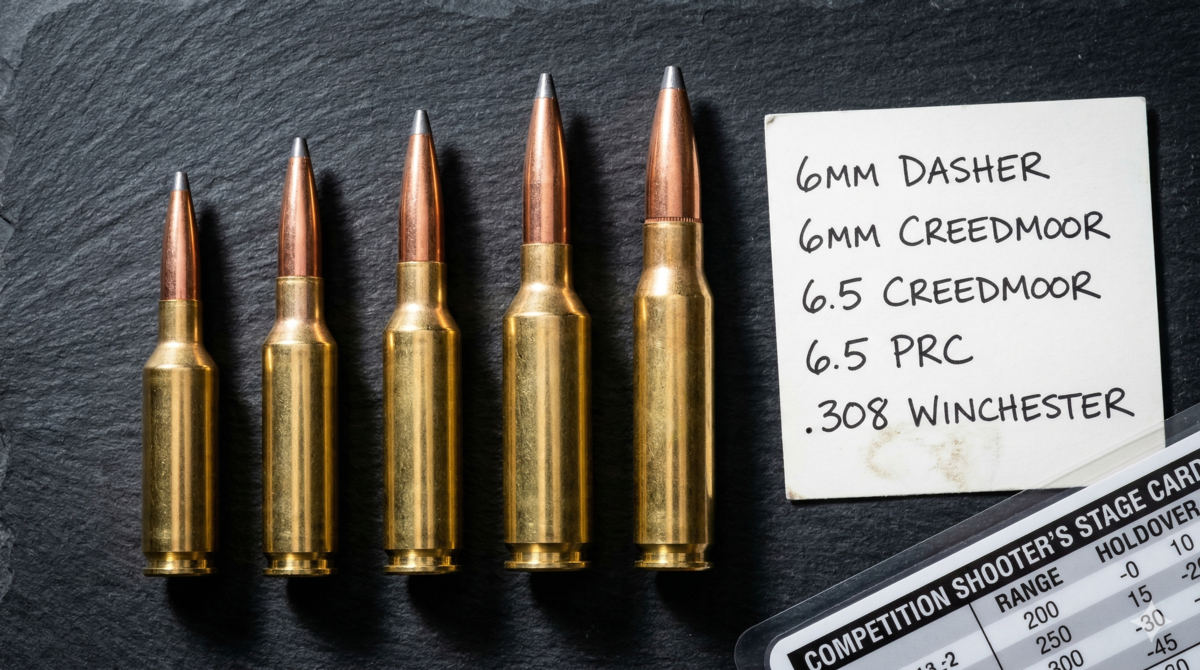
Walk the firing line at any major PRS match, and you'll notice something that might surprise newer shooters: the top competitors aren't running exotic wildcats or chasing the latest cartridge trend. They're running proven rounds with obsessive attention to consistency. This isn't about brand loyalty or marketing hype — it's about data.
How Elite Shooters Actually Choose Ammunition
Top-tier precision shooters make cartridge decisions based on hard numbers from their chronographs. Standard deviation (SD) and extreme spread (ES) aren't just statistics — they're the difference between hits and misses at 1,000 yards. SD measures how consistently your muzzle velocity varies from shot to shot, while ES shows the gap between your fastest and slowest rounds in a string.
When a competitor tells you their handload runs an SD of 6 fps and an ES under 20, they're not bragging — they're explaining why they can call their shots. A 20 fps velocity variation translates to roughly 6 inches of vertical spread at 1,000 yards. In a sport where targets are often 12 inches or smaller, that consistency becomes the foundation everything else builds on.
The best shooters also understand barrel-specific performance. A cartridge that shoots sub-MOA in one rifle might struggle to break 1.5 MOA in another, even with identical components. This is why serious competitors develop loads for their specific barrel rather than copying someone else's recipe.
The 6.5 Creedmoor Takeover
The 6.5 Creedmoor's dominance in PRS and NRL competition isn't marketing magic — it's practical ballistics meeting competitive demands. The cartridge delivers high ballistic coefficient projectiles with moderate recoil, allowing faster follow-up shots and better spotting of impacts through the scope.
At the 300-1,200 yard stage distances common in precision rifle competition, the 6.5 Creedmoor provides the perfect balance. It carries enough energy to reliably activate steel targets while remaining controllable for rapid engagement sequences. Factory ammunition from quality manufacturers consistently delivers sub-MOA accuracy, making it accessible to shooters who can't or won't handload.
The component ecosystem matters too. Bullet selection in 6.5mm runs deep, from 130-grain options for shorter stages to 147-grain heavies for maximum BC. Brass is readily available, and powder choices are well-documented across thousands of load combinations. This infrastructure allows shooters to fine-tune performance without breaking new ground.
Where 6.5 PRC Steps In
The 6.5 PRC represents the next logical step for shooters who've maximized their Creedmoor's potential and need more performance at distance. With roughly 200 fps additional velocity, the PRC extends effective range and improves wind-bucking ability. But this performance comes with tradeoffs.
Barrel life decreases significantly — where a Creedmoor might deliver 3,000+ accurate rounds, a PRC barrel often shows throat erosion by 1,500-2,000 rounds. Recoil increases noticeably, affecting spotting ability and follow-up shot speed. Component costs rise, and finding load data requires more experimentation.
The shooters who make this transition are typically those competing at the highest levels, where stage distances regularly push beyond 1,000 yards and wind calls become increasingly critical. For most precision rifle competitors, the Creedmoor's performance envelope covers their needs completely.
Why .308 Winchester Isn't Finished
Despite being overshadowed by newer cartridges, the .308 Winchester maintains relevance in specific contexts. Military and law enforcement precision applications still heavily favor it, not just for logistical reasons but for proven terminal performance.
In competition, the .308 remains viable at distances under 800 yards when loaded with consistent ammunition. Its advantages include unmatched component availability, superior suppressor performance due to subsonic capability with heavy bullets, and decades of load development data.
The .308's real strength lies in its predictability. Experienced shooters know exactly what to expect from quality .308 ammunition. While it won't match the ballistic coefficient of 6.5mm options, a skilled shooter running consistent .308 loads can remain competitive in many match formats.
The Specialist Cartridges
At the very top of competition leaderboards, you'll occasionally see cartridges like 6mm Dasher, 6mm Creedmoor, or .284 Winchester. These aren't better than mainstream options for most shooters — they're solutions to specific problems at the highest competitive levels.
The 6mm Dasher, for example, offers exceptional accuracy potential with moderate powder consumption, making it attractive for high-round-count matches. But it requires extensive handloading knowledge and component preparation that most shooters won't pursue.
These specialist cartridges exist because elite competitors have already optimized everything else — rifle, optics, technique, and standard cartridge performance. Only then do the marginal gains from exotic chamberings become worthwhile.
Consistency Trumps Everything
Regardless of cartridge choice, the fundamental truth remains constant: consistent ammunition beats superior ballistics every time. The best cartridge running erratic velocity will lose to a lesser cartridge delivering predictable performance.
This is why top competitors obsess over lot-to-lot consistency, brass preparation, and charge weight uniformity. It's why they track standard deviation across hundreds of rounds and adjust loads based on chronograph data rather than group size alone.
At ZeroPoint, we understand this reality because we compete in these same matches. Our ammunition meets the consistency standards that precision shooters actually require, not marketing claims about theoretical accuracy. When your hit probability depends on single-digit standard deviations, every component and process must deliver accordingly.