
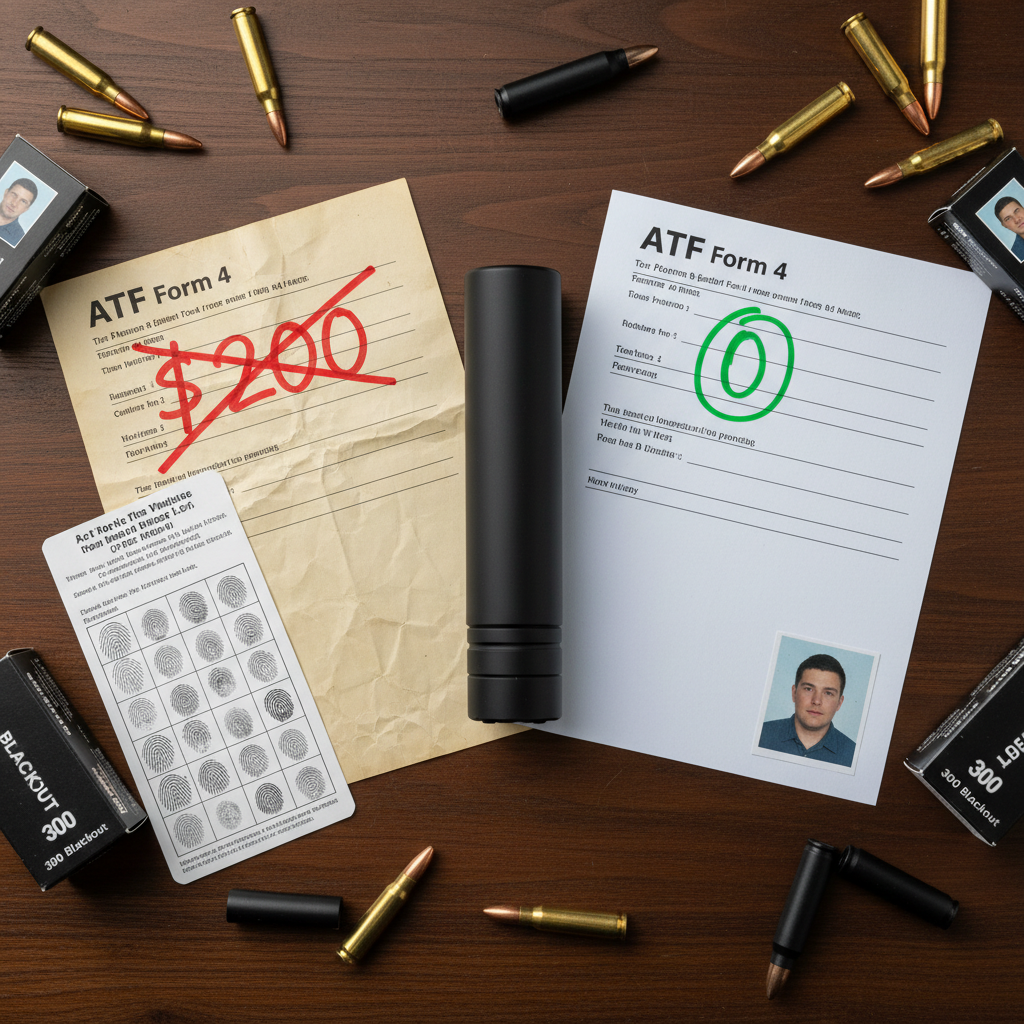
January 1, 2026 marked the biggest victory for NFA items in 90 years: the complete elimination of the $200 tax stamp for suppressors, short-barreled rifles, short-barreled shotguns, and AOWs. Yet if you want to buy a suppressor today, you'll still fill out Form 4, submit fingerprints and a passport photo, and wait for ATF approval.
The celebration feels incomplete because it is. Here's what actually changed, what the ongoing legal fight means, and how to navigate the current suppressor buying process.
What the One Big Beautiful Bill Actually Did
Signed into law on July 4, 2025, the One Big Beautiful Bill Act eliminated the $200 excise tax on NFA items effective January 1, 2026. This represents the first substantial NFA reform since the National Firearms Act became law in 1934.
The financial barrier is gone, but the regulatory framework remains intact:
- ATF Form 4 (for dealer transfers) or Form 1 (for manufacturing) still required
- Fingerprint cards and passport photos still mandatory
- Chief Law Enforcement Officer (CLEO) notification still applies
- ATF approval still needed before possession
- Background check processing times unchanged
What changed most dramatically is suppressor accessibility. Without the $200 tax, entry-level suppressors now cost what they actually cost—often $300-500 instead of $700+ with the stamp.
Why the Hearing Protection Act Language Got Stripped
The original plan was full deregulation through Hearing Protection Act language: no tax, no registration, no fingerprints, just a standard NICS background check like any firearm purchase.
The Senate Parliamentarian killed that vision under the Byrd Rule, which prohibits non-budgetary provisions in reconciliation bills. Since HPA's complete deregulation went beyond simple tax elimination, it couldn't survive parliamentary review.
What emerged was a compromise: eliminate the tax (a budgetary provision that passed muster) while leaving the regulatory structure untouched.
The Constitutional Challenge That Could Change Everything
The Silencer Shop Foundation and Gun Owners of America aren't settling for half-measures. Their federal lawsuit argues that without the tax, the entire NFA registration scheme loses its constitutional foundation.
The legal theory is straightforward: the Supreme Court upheld the original NFA in 1939 as a tax measure under Congress's taxing power. Remove the tax, and the constitutional justification disappears. What remains is federal registration of lawfully owned property—something Congress lacks clear authority to mandate.
Fifteen states have joined as amici curiae supporting the plaintiffs, arguing that the registration requirements now constitute an unconstitutional federal overreach into state police powers.
The Stakes of This Lawsuit
If successful, this challenge could eliminate:
- All NFA registration requirements
- ATF approval processes for suppressors, SBRs, and SBSs
- Fingerprinting and photo requirements
- CLEO notification mandates
- Transfer restrictions on NFA items
Suppressors would become regular firearms accessories, regulated like any other gun part.
How to Buy a Suppressor in 2026
Despite the tax elimination, the process remains bureaucratic. Here's the current step-by-step:
- Choose your suppressor based on caliber compatibility and intended use
- Purchase from an SOT dealer (Special Occupational Taxpayer with proper licensing)
- Complete ATF Form 4 with all required information
- Submit fingerprint cards (two sets) and passport photo
- Provide CLEO notification to local law enforcement
- Wait for ATF approval—currently 6-12 months average
- Complete Form 4473 and NICS check when approved
- Take possession from your dealer
The only difference from pre-2026: no $200 payment to ATF.
Market Impact: Suppressor Sales Surge
Eliminating the tax barrier has predictably increased suppressor interest. Industry reports show:
- Form 4 submissions up 340% since January 1
- First-time NFA buyers comprise 60% of new applications
- Budget suppressor sales increased 400%
- Wait times extending as ATF processes volume increases
For ammunition manufacturers like ZeroPoint, this represents opportunity. More suppressed firearms mean more demand for subsonic loads optimized for quiet operation, particularly in .300 Blackout subsonic and 9mm subsonic configurations.
What Happens Next
The constitutional challenge will likely take 18-24 months to work through federal courts. Meanwhile, Congress could act independently to pass standalone HPA legislation, though that would require 60 Senate votes—a higher bar than the reconciliation process that eliminated the tax.
ATF has indicated it's preparing for continued high application volume and may adjust processing procedures, though no timeline exists for meaningful wait time reductions.
The Bottom Line
January 1, 2026 delivered the biggest NFA victory in decades, but it's an incomplete victory. The tax is gone, making suppressors financially accessible to millions more Americans. The regulatory burden remains, creating ongoing friction between constitutional rights and federal bureaucracy.
Whether the courts or Congress finish the job remains to be seen. What's certain: American gun owners won't settle for half-measures when constitutional rights hang in the balance.