
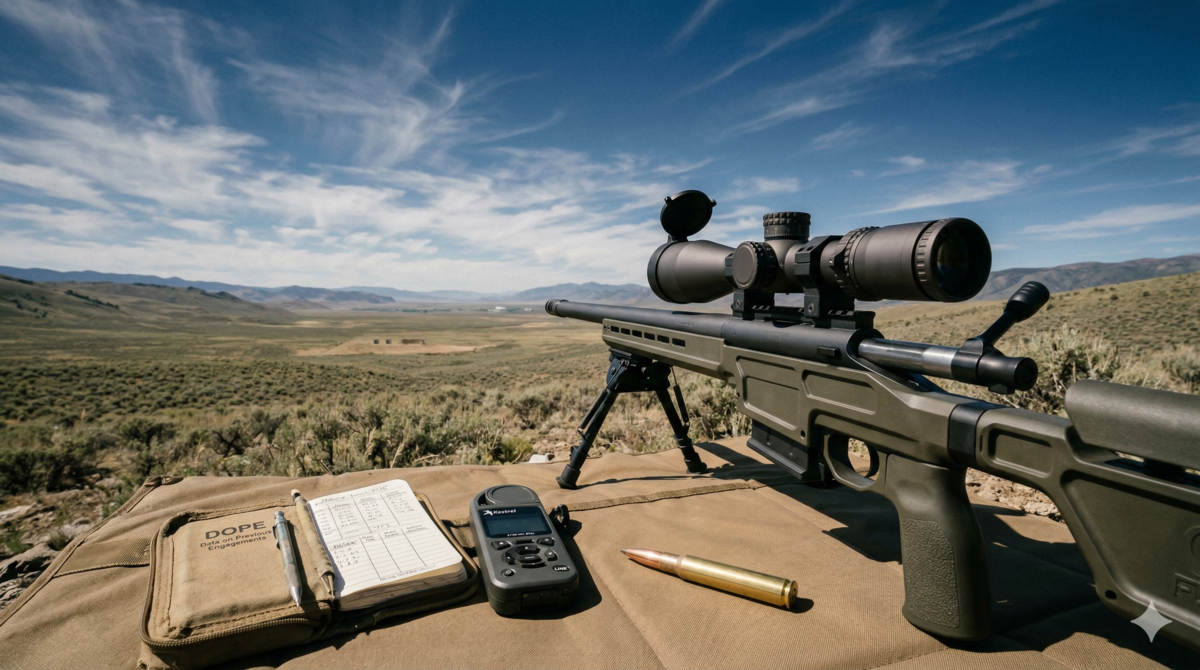
When we talk about extreme long range shooting, we're discussing a discipline that operates in an entirely different physics environment than most shooters ever experience. We're not talking about the impressive 600-yard shot at your local range — we're talking about consistently connecting at 1,500 yards and beyond, out to distances where the curvature of the earth itself becomes a factor in your calculations.
The Reality of Extreme Long Range
At these distances, everything changes. That gentle breeze you barely noticed at 300 yards now moves your bullet several feet off target. Atmospheric pressure, humidity, and temperature shifts that seemed academic suddenly determine whether you connect or miss by yards. The Coriolis effect — the rotation of the earth itself — begins influencing bullet flight. Your projectile may go transonic during flight, creating unpredictable stability issues that can scatter shots despite perfect form and equipment.
This isn't about showing off or pursuing some arbitrary milestone. Extreme long range shooting demands a level of precision and consistency that pushes both shooter and equipment to their absolute limits. It's a discipline where every variable matters, where small compromises compound into major problems, and where the margin for error essentially disappears.
Why Traditional Magnums Reach Their Limits
The .300 Winchester Magnum and 7mm Remington Magnum are outstanding cartridges — we've seen them perform beautifully in hunting scenarios and precision shooting applications for decades. But when we push beyond 1,200-1,300 yards, their limitations become apparent.
Most traditional magnums struggle to keep heavy, high-ballistic coefficient projectiles supersonic past 1,500 yards in standard atmospheric conditions. They were designed during an era when 500-yard shots represented the absolute extreme of practical shooting. The case geometry and powder capacity that made them revolutionary in their time simply weren't optimized for the ultra-heavy bullets and extended ranges that define modern ELR shooting.
When these cartridges go transonic — that critical velocity range where the bullet transitions from supersonic to subsonic flight — accuracy becomes unpredictable. The same load that produces sub-MOA groups at 1,000 yards might scatter shots across multiple feet of target at 1,600 yards, not due to any fault in the rifle or shooter, but because the cartridge has reached the edge of its effective envelope.
The .300 Norma Magnum's Engineering Advantage
The .300 Norma Magnum was developed through direct collaboration with SOCOM specifically for long-range precision applications. This wasn't a marketing exercise — it was purpose-built ammunition designed to meet the demands of professional users who needed reliable performance at extreme distances.
The case geometry allows efficient burning of large powder charges behind heavy bullets in the 230-grain class and beyond. Where a .300 Winchester Magnum might struggle to stabilize and accelerate a 230-grain projectile to useful velocities, the .300 Norma Magnum handles these bullets as standard operating procedure. This means access to projectiles with ballistic coefficients well above 0.700 G1, bullets that retain energy and resist wind deflection far better than lighter alternatives.
The result is retained supersonic velocity well beyond 1,500 yards in most atmospheric conditions, keeping shots predictable and accurate throughout the entire flight path. Recoil, while substantial, remains manageable relative to the performance delivered — an important consideration when you need to spot your own shots and maintain consistent form across multiple rounds.
Perhaps most importantly, the .300 Norma Magnum achieved SAAMI standardization, meaning genuine factory support and consistent chamber specifications across manufacturers. This isn't some wildcatted experiment — it's a legitimate, standardized cartridge with a growing support infrastructure.
Reading Conditions and Executing the Shot
At 1,500 yards, that 10-mph crosswind you might barely notice at closer ranges will move your bullet approximately 4-5 feet horizontally. A 5-mph wind you wouldn't even feel on your face still pushes the projectile over two feet off point of aim. This is why ELR shooting demands environmental monitoring equipment — Kestrel weather meters, range cards, and detailed DOPE books aren't accessories, they're essential tools.
Shot calling becomes critical. You must be able to analyze each shot immediately, identifying whether a miss resulted from wind reading error, equipment issues, or execution problems. The feedback loop is longer at these distances — you might not see impact for two full seconds after breaking the shot — but the information is just as valuable.
Here's where ammunition consistency becomes absolutely non-negotiable. That 50-fps velocity spread that produces acceptable results at 300 yards translates to several inches of vertical dispersion at 1,500+ yards. When your target might be a 12-inch square at over a mile away, you cannot afford to give up precision to ammunition inconsistency.
Platform Requirements for ELR Success
The .300 Norma Magnum demands quality equipment. A lightweight hunting rifle with a thin barrel will not deliver the consistency needed for ELR work. Heavy barrel profiles minimize heat-related precision degradation. Quality actions ensure consistent lockup and timing. Long-range optics with reliable tracking and sufficient elevation adjustment become mandatory — you might need 35-40 MOA of elevation adjustment for a 1,500-yard shot, depending on your zero distance.
Bipods and rear bags represent the minimum acceptable support. Many ELR shooters move to more substantial rest systems, but regardless of your choice, the platform must be stable enough to hold steady during the extended time required to read conditions and execute the shot.
This isn't a budget discipline, and pretending otherwise serves no one. Quality equipment costs money, but at these distances, compromising on any component typically means compromising on results.
Why We Developed Our Precision Series
Factory ammunition from large manufacturers rarely delivers the lot-to-lot consistency that ELR shooting demands. When we're talking about shots where a few inches determine success or failure, the typical factory ammunition variation becomes unacceptable.
Our Precision Series exists specifically for the shooter who has invested seriously in their platform and refuses to let inconsistent ammunition be the variable that ruins a perfect shot. Every round is hand-loaded to specifications that prioritize consistency above all else. We're talking about single-digit velocity spreads, carefully selected components, and quality control measures that simply aren't economically viable in mass production.
The .300 Norma Magnum represents the intersection of cartridge performance and shooter capability. When both elements align — when the cartridge delivers the ballistic performance and the ammunition provides the consistency — extreme long range shooting transforms from luck-dependent to skill-dependent. That's when the real fun begins.